Findings & Reports
Findings
Where: Code Command Center → Findings.
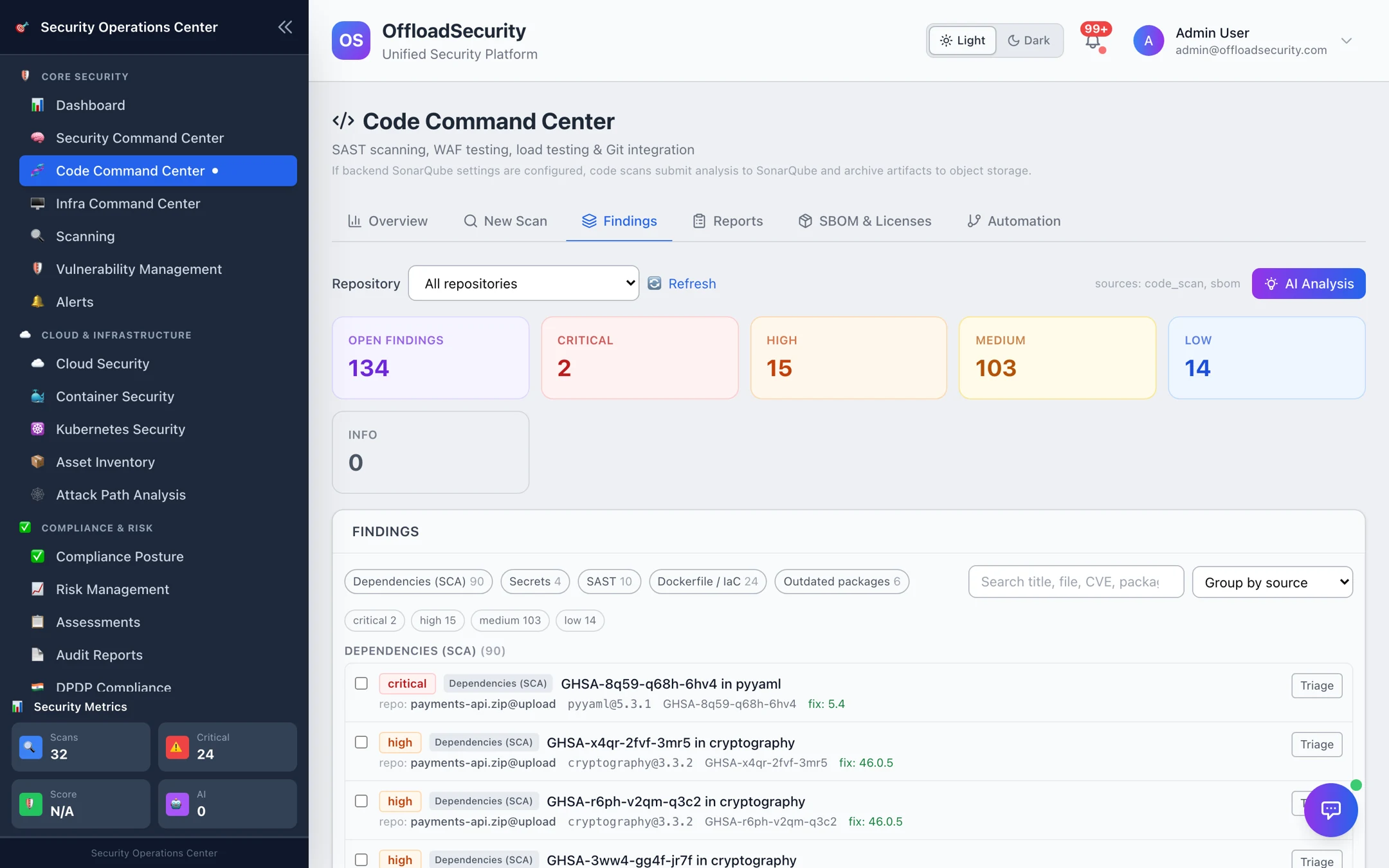
The Findings tab is the cross-repository triage list. Pick a repository (or all), and the tiles show open findings by severity. Findings are grouped by source — Dependencies (SCA), Secrets, SAST, Dockerfile / IaC, Outdated packages — with a per-group severity breakdown, and can be searched by title, file, CVE or package. AI Analysis summarises the current view: what is exploitable, what is noise, where to start.
Each row shows severity, source, the identifier (rule, CVE/GHSA, detector or Checkov check), the location (file and line, or package and version) and, for dependencies, the fixed version plus KEV (actively exploited) and EPSS badges. Open a row for the code context or advisory text, the remediation, the activity history and comments.
Lifecycle
Every finding starts open. Triage records a decision that survives re-scans:
| Decision | Requires | Effect |
|---|---|---|
| Resolved | — | Closed; re-detected on a later scan → reopened automatically. |
| Accept risk (time-bound) | Owner, justification, expiry | Hidden from open counts until the expiry, then returns for review. Under the Production policy pack acceptances also need an approver and are capped at 30 days (90 under Baseline). |
| False positive | Justification | Excluded from counts, scores and reports; kept on the finding. |
| Reopen | — | Returns an accepted or resolved finding to open. |
Attach evidence (a link or note) to any decision; it appears in the activity log and in exports, which is what an auditor asks for when they see an accepted critical. Decisions can be applied in bulk to a selection.
Fixing
- AI Fix Suggestion drafts the code change for a SAST finding or the upgrade for a dependency, with an explanation.
- Fix PR pushes a branch with the change and opens a pull request on the connected provider (GitHub, GitLab or Bitbucket). This is the only code-scanning action that writes to your repository; it needs the Execute Remediations permission and a token with pull-request write access. The PR body links back to the finding.
- Copy PR body and Copy upgrade commands are available when you would rather open the change yourself.
Dependency findings usually outnumber everything else and are the cheapest to fix — a version bump. Filter to KEV-flagged and fixable high/critical dependencies, ship those, then work SAST criticals with the code context in front of you.
Scan reports
Where: Code Command Center → Reports.
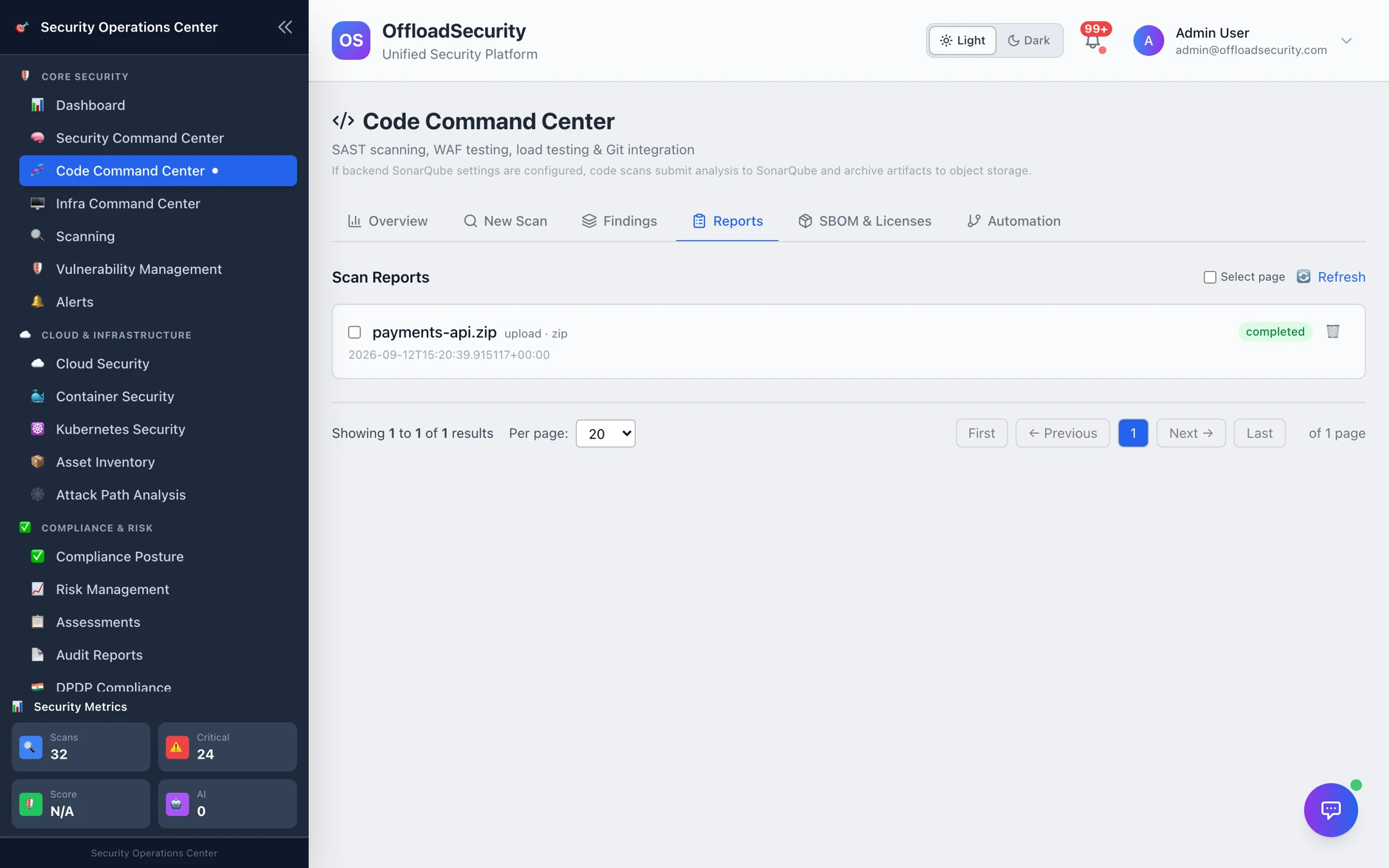
One report per scan: source (repository and branch, or upload), type, status (completed, completed with errors when a tool failed, failed) and date. Filter with Show: application / owner once repositories are mapped (Repository ownership). Select several and Delete to prune.
Open a report for the detail view:
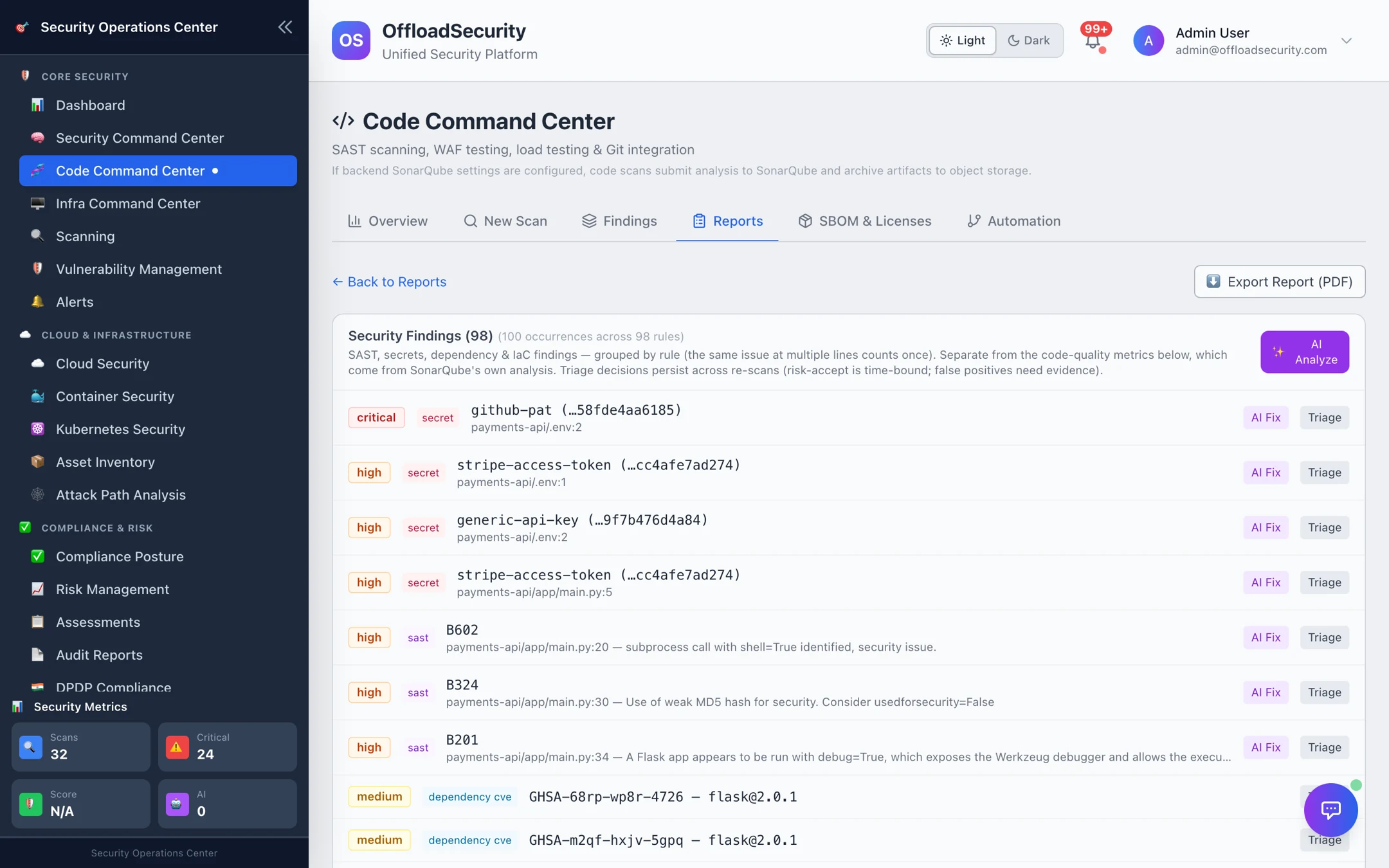
- Security findings for that scan, grouped by tool, with the same triage and AI actions as the Findings tab.
- Artifact / image scan results when the scan was of a build artifact or compiled image.
- SonarQube report when SonarQube is configured — the platform stores the report artifact and links it.
- AI Analysis of the whole scan and Export Report (PDF) for a release record or an auditor.
Where code findings go next
- Vulnerability Management — SCA and image CVEs appear in the unified view with SLAs and ownership (Vulnerability Management).
- Risk Register — promote an accepted critical into a tracked risk (Risk Register).
- Release gates — the same findings drive the pass/fail decision in CI (CI/CD & Automation).
Related
- Running Code Scans — producing the findings.
- SBOM & Licences — the inventory and licence side of the same scans.
- Scanning API — findings lifecycle, reports and exports over REST.